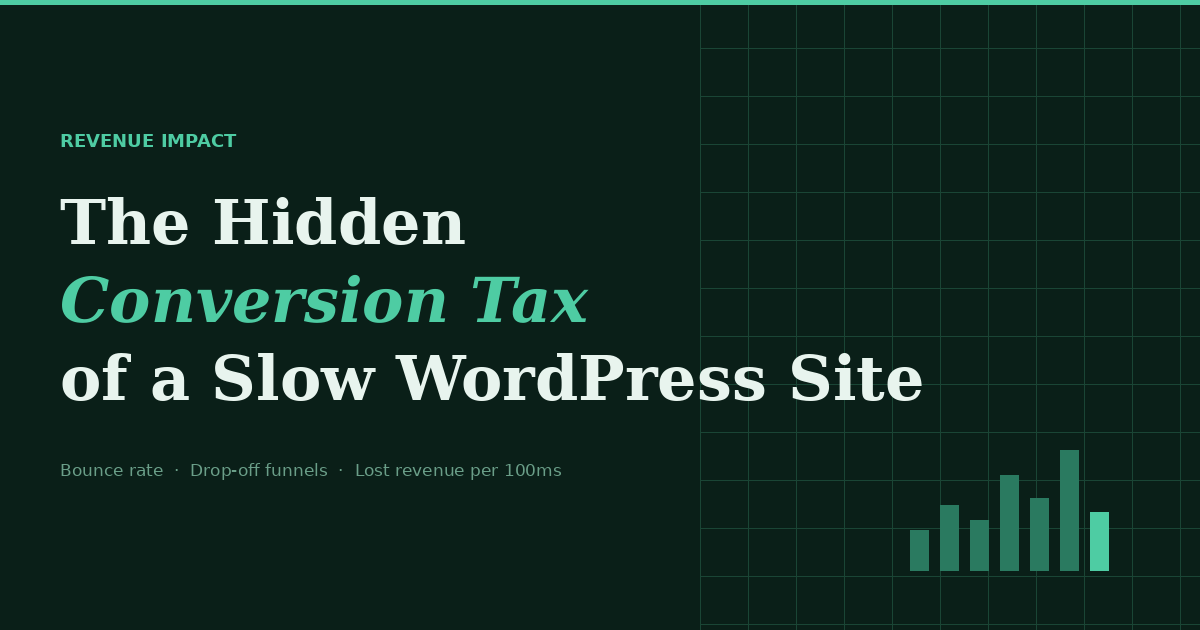
The Hidden Conversion Tax of a Slow WordPress Site
 WordPress Development
|
WordPress Development
|  3 minutes
Speed isn’t a technical metric — it’s a revenue metric. Every extra second your WordPress site takes to load is quietly siphoning money from your business. Not in ways that show up on an invoice, but in abandoned carts, bounced visitors, and leads that never became customers. This is the conversion tax, and most site owners are paying it without realizing it.
The Numbers Are Brutal
Google’s research has shown that as page load time increases from one second to three seconds, the probability of a visitor bouncing increases by 32%. Push that to five seconds, and the likelihood of a bounce jumps to 90%. These aren’t edge cases — they’re the average behavior of real users with real purchasing intent, clicking away before your homepage even finishes rendering.
For an e-commerce site doing $50,000 a month, even a 10% improvement in conversion rate from speed optimization can mean $5,000 in additional monthly revenue. The inverse is equally true: a slow site that’s bleeding conversions may be costing far more than the infrastructure savings justify.
Where the Tax Gets Collected
The conversion tax isn’t charged in one place — it accumulates across the entire user journey. A slow product page means fewer add-to-carts. A sluggish checkout flow means more abandoned transactions at the worst possible moment, when purchase intent is highest. Slow-loading blog posts mean lower time-on-site, fewer email signups, and reduced SEO rankings — which reduces the quality of future traffic.
WordPress sites are particularly vulnerable because slowness is often invisible to the people running them. Developers test on fast office Wi-Fi. Founders demo on MacBooks. But a significant portion of your real audience is on mobile, on average connections, in conditions your internal testing never replicates.
Struggling With WordPress Performance At Scale?
Google Is Also Taxing You
Since Google’s Core Web Vitals became a ranking factor, site speed directly affects organic visibility. A slow WordPress site doesn’t just convert poorly — it ranks lower, which means fewer visitors to convert in the first place. The tax compounds: slower site → lower rankings → less traffic → fewer conversions → less revenue to invest in fixing the problem.
The Fix Is an Investment, Not a Cost
The good news is that speed improvements on WordPress have some of the highest ROI of any technical investment. Implementing full-page caching, optimizing images, deferring non-critical JavaScript, and upgrading to a performance-focused host can cut load times by 40–60% without touching your content or design.
The businesses that treat performance as a growth lever — not an IT checkbox — are the ones that compound their conversion rates over time. Every millisecond saved is a fraction of a bounce prevented, a cart completed, a customer retained.
 June 25, 2026
 WordPress Development
 WordPress Development
 WordPress Development
 WordPress Development