WordPress Infrastructure Cost: When “Good Enough” Fails
 WordPress Development
|
WordPress Development
|  4 minutes
Table of Contents
- The Threshold Problem
- What Good Enough Actually Costs
- The Hidden Cost: Developer Time
- When Good Enough Starts Hurting
“Good enough” is a reasonable standard for a lot of things. For WordPress infrastructure powering a growing business, it’s a slow leak. The site loads. The checkout works. Nobody is actively complaining. So the hosting plan stays the same, the database configuration goes untouched, and caching remains whatever the default was at setup. Meanwhile, the business pays the price in ways that never appear as a line item.
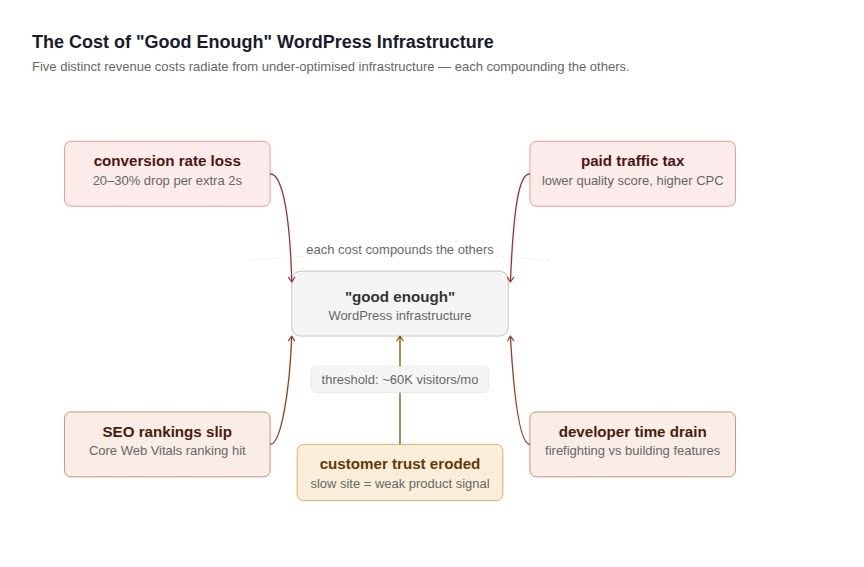
The cost of good-enough infrastructure is not a single catastrophic failure. It’s the accumulation of small, invisible losses — conversions that didn’t happen, rankings that slipped, ad spend that didn’t return what it should have, customers who bought from a faster competitor. Each individual loss is undetectable. The cumulative impact over months and years is significant.
The Threshold Problem
Infrastructure that is genuinely adequate for a site’s current size stops being adequate at some point, and that point is rarely announced in advance. A hosting plan that handled 25,000 monthly visitors without issue begins to strain at 60,000. A database configuration that worked fine for a 500-product WooCommerce catalog becomes a bottleneck at 5,000 products. The transition from adequate to inadequate happens gradually, then suddenly — usually during a traffic spike that reveals fragility the team didn’t know existed.
The businesses most vulnerable to this threshold problem are the ones growing fastest. Growth increases traffic, transaction volume, database complexity, and concurrent user load simultaneously. Each dimension adds pressure to infrastructure that was sized for a smaller operation. Good enough at launch becomes dangerously inadequate eighteen months later, and the symptoms are often misdiagnosed as marketing problems or product issues before anyone looks at the server.
What Good Enough Actually Costs
The most measurable cost is in conversion rate. Research on page speed and conversion is consistent and unambiguous: slower pages convert at lower rates, and the relationship is not subtle. A site loading in four seconds rather than two can see conversion rates fall by 20 to 30 percent. For an e-commerce site doing $200,000 in monthly revenue, that’s a potential $40,000 to $60,000 per month in unrealized sales — not from bad products or weak marketing, but from infrastructure that was never optimized.
The second cost is paid traffic efficiency. Google and Meta factor landing page experience into ad quality scores. Slow, poorly performing pages receive lower quality scores, which means you pay more per click to reach the same audience. Good-enough infrastructure effectively functions as a tax on every paid campaign you run — one that compounds as you scale spend.
The third cost is organic visibility. Core Web Vitals are a confirmed Google ranking factor. A site with consistently poor LCP, high INP, or unstable CLS will underperform in organic search relative to faster competitors targeting the same keywords. The gap compounds over time as competitors invest in performance and your site falls behind in both rankings and user experience.
Struggling With WordPress Performance At Scale?
The Hidden Cost: Developer Time
Poorly optimized WordPress infrastructure creates ongoing development overhead that teams rarely account for. Debugging intermittent performance issues, investigating mysterious checkout failures, firefighting during traffic spikes, and managing plugin conflicts on an under-resourced server all consume developer time that could be spent building features or improving the product. Good-enough infrastructure doesn’t just cost money directly — it taxes your team’s capacity to do high-value work.
When Good Enough Starts Hurting
The clearest signal is a growing gap between traffic and revenue. If your visitor numbers are rising but your conversion rate is flat or declining, infrastructure deserves investigation before any other variable. The second signal is inconsistent performance — pages that load quickly sometimes and slowly other times, indicating a server under variable load without sufficient resources to maintain consistent response times.
A basic performance audit — running your key pages through Google PageSpeed Insights, checking your server TTFB under load, and reviewing your hosting plan against your actual traffic volume — takes a few hours and typically reveals whether good enough has stopped being good enough.
The cost of upgrading WordPress infrastructure is almost always modest relative to the revenue it protects. A managed hosting upgrade, a proper caching layer, and a CDN typically cost hundreds of dollars per month. The conversion rate improvement from even a one-second reduction in load time on a site doing meaningful revenue pays for years of infrastructure investment in weeks.
Good enough got you here. It won’t get you where you’re going.
 July 2, 2026
 WordPress Development
 WordPress Development
 WordPress Development
 WordPress Development