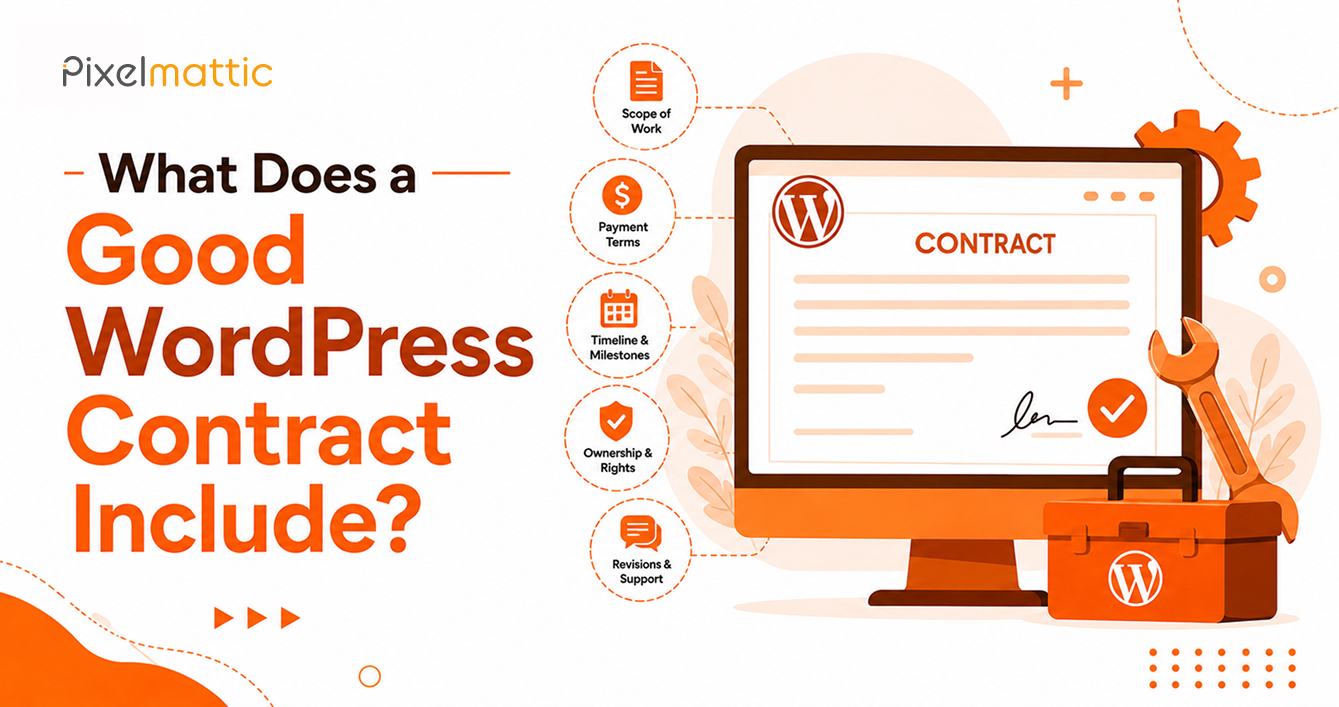
What Does a Good WordPress Contract Include?
 WordPress Development
|
WordPress Development
|  4 minutes
Table of Contents
- Scope of Work
- Timeline and Milestones
- Payment Terms
- Intellectual Property Ownership
- Revision and Change Request Policy
- Post-Launch Support and Warranty
- Handover and Documentation
- Termination Clause
- Confidentiality and Non-Disclosure
- Frequently Asked Questions
A verbal agreement or a few email exchanges might feel sufficient when you’re excited to get a project started, but the absence of a proper contract is one of the most common causes of disputes in website development. A well-structured contract protects you, sets clear expectations for the developer, and gives both parties a reference point if disagreements arise.
This guide covers exactly what a good WordPress development contract should include, so you know what to look for — or ask for — before signing.
Scope of Work
This is the foundation of any contract. It should specify: the number of pages and their purpose, specific functionality to be built (forms, integrations, custom features), whether content creation is included or the client’s responsibility, the design process and number of concept options, and explicitly what is NOT included, to prevent scope creep disputes later.
Vague scope language like ‘build a modern business website’ invites disagreement. Specific, itemised scope protects both parties.
Timeline and Milestones
A proper contract includes a project timeline broken into milestones — discovery, design approval, development, content integration, testing, and launch — each with target dates. It should also specify what happens if delays occur on either side: does a client-caused delay (like late content delivery) shift the developer’s obligations, and does a developer-caused delay trigger any compensation or remedy?
Payment Terms
This section should specify the total project cost, the payment schedule (commonly 30–40% upfront, a milestone payment, and the balance on delivery), accepted payment methods, and what happens in case of late payment or non-payment. It should also clarify whether the quoted price is fixed or subject to change if scope changes are requested.
Intellectual Property Ownership
This is one of the most important — and most frequently overlooked — clauses. The contract should explicitly state that upon final payment, you own the website’s code, design files, and content outright. Without this clause, ownership can become ambiguous, particularly with custom code or design assets.
Be cautious of contracts that grant only a ‘licence to use’ rather than full ownership — this can create significant problems if you later want to switch developers.
Revision and Change Request Policy
The contract should specify how many rounds of revisions are included at each stage (design, development), what qualifies as a revision versus a new feature request, and how additional revisions or scope changes beyond what’s included will be priced and approved.
Post-Launch Support and Warranty
A good contract clarifies: what happens if bugs are discovered shortly after launch (a warranty period of 30 days is common), whether ongoing maintenance is included or a separate service, and the process for reporting and resolving post-launch issues.
Handover and Documentation
Specify exactly what you’ll receive at project completion: all source files and code, admin and hosting credentials, documentation of custom functionality, and any relevant licences for premium plugins or themes purchased during the project.
Termination Clause
This outlines the conditions under which either party can end the agreement before completion, what happens to work completed up to that point, and how any partial payments or refunds are handled. This clause becomes critical if a developer becomes unresponsive or if either party needs to exit the engagement.
Confidentiality and Non-Disclosure
If your project involves sensitive business information, proprietary processes, or confidential data, include a confidentiality clause protecting that information from disclosure.
WordPress Contract
Want to Work With a WordPress Agency That Operates on Clear, Fair Contracts From the Start?
Request a sample contract and proposal from Pixelmattic.
Frequently Asked Questions
Do I need a lawyer to review a WordPress development contract?
For smaller projects, a well-structured standard contract covering the elements above is usually sufficient. For larger or higher-risk projects, having a lawyer review the contract is a reasonable investment.
What happens if a WordPress contract doesn’t specify IP ownership?
Without clear IP ownership language, disputes can arise over who legally owns the code, design, and content — particularly problematic if you want to switch developers or make changes independently in future.
Can I change the scope of a WordPress project after signing the contract?
Yes, but any change should go through a formal change request process, with agreed pricing and timeline adjustments documented in writing, rather than being handled informally.
 October 1, 2026
 WordPress Development
 WordPress Development
 WordPress Development
 WordPress Development