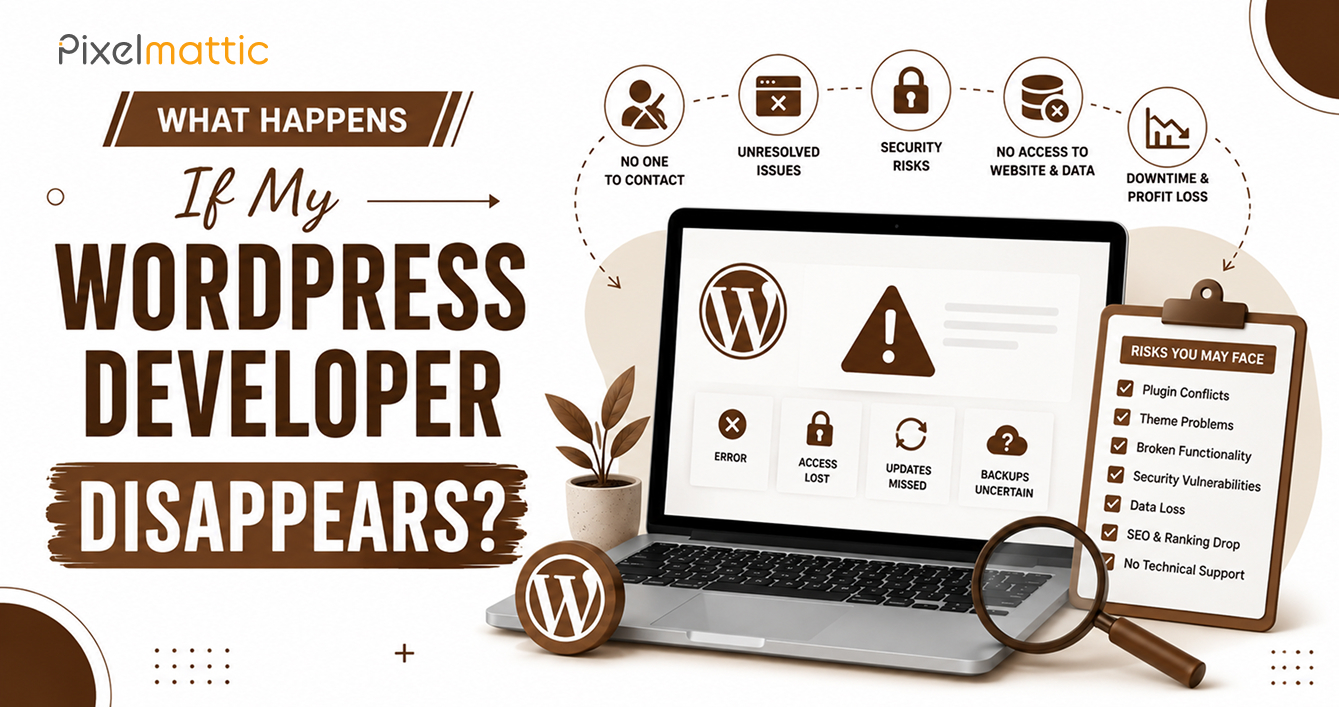
What Happens If My WordPress Developer Disappears?
 WordPress Development
|
WordPress Development
|  4 minutes
Table of Contents
- Protecting Yourself Before It Happens
- If Your Developer Has Already Disappeared
- What a New Developer Will Need From You
- The Longer-Term Lesson
- Frequently Asked Questions
It’s an uncomfortable but genuinely common scenario in web development: a freelancer or small agency simply stops responding. Maybe they took on too many clients, changed careers, or ran into personal circumstances. Whatever the cause, business owners are left with an unfinished or unsupported website and understandable anxiety about what to do next.
This guide covers both prevention — how to protect yourself before this happens — and recovery — what to do if you find yourself in this exact situation right now.
Protecting Yourself Before It Happens
Never pay 100% upfront: Structuring payment across milestones (30–40% upfront, a mid-project payment, and the balance on delivery) limits your financial exposure if the relationship ends prematurely.
Maintain independent access to critical accounts: Ensure you personally own and have direct access to your domain registration, hosting account, and any third-party services (email, analytics) — never solely through the developer’s own accounts.
Request regular exports or backups during the project: Ask for periodic access to a working copy of the site, even mid-project, so you’re never entirely dependent on the developer’s environment.
Use a written contract with clear milestones: A contract makes it easier to establish what’s owed and what recourse you have if a developer becomes unresponsive.
Choose an agency over a solo freelancer for business-critical projects: Agencies have institutional continuity — if one team member becomes unavailable, the project and support relationship continue.
If Your Developer Has Already Disappeared
Step 1 — Attempt contact through multiple channels: Email, phone, any project management tool used, and social media if necessary. Document every attempt with timestamps.
Step 2 — Assess what you actually have access to: Check whether you have your own hosting account access, domain registration, and any available source files or backups. This determines your realistic recovery options.
Step 3 — Recover access to your hosting and domain: If the developer registered these on your behalf without transferring ownership to you, contact the domain registrar and hosting provider directly — most have processes for account ownership disputes, though this can take time.
Step 4 — Engage a new developer to assess the situation: A new developer can review what exists on your hosting account (even without cooperation from the original developer) and assess what’s recoverable versus what needs to be rebuilt.
Step 5 — Consider your payment recovery options: If you paid via a platform with escrow protection (like Upwork), file a dispute immediately. If paid via bank transfer with a signed contract, consult a legal professional about recovery options, particularly for substantial amounts.
What a New Developer Will Need From You
To pick up an abandoned project efficiently, gather: hosting account access (or work with your new developer to recover it), your domain registrar login, any available backups or exports, the original project brief or contract (to understand what was supposed to be delivered), and any documentation, however minimal, from the original developer.
The Longer-Term Lesson
This situation, while stressful, is almost always recoverable — provided you maintain independent ownership of your core digital assets (domain, hosting, and ideally, regular backups). The single most important preventive measure is ensuring you, not your developer, control the accounts your business depends on.
WordPress Project Recovery
Left in a Difficult Spot by an Unresponsive Developer?
Get a fast, judgement-free project assessment from Pixelmattic and a clear path forward.
Frequently Asked Questions
What should I do if my WordPress developer stops responding?
First, attempt contact through multiple channels and document your efforts. Then verify what access you have to your own hosting and domain accounts, and engage a new developer to assess recovery options based on what’s actually available.
How do I get my website back if the developer controlled my hosting account?
Contact the hosting provider directly with proof of business ownership (invoices, contracts, payment records). Most providers have a formal account recovery or ownership dispute process, though resolution time varies.
How can I prevent this from happening on my next project?
Ensure you personally own your domain and hosting accounts from day one, structure payments across milestones rather than upfront in full, and consider working with an established agency rather than a solo freelancer for business-critical projects.
 September 22, 2026
 WordPress Development
 WordPress Development
 WordPress Development
 WordPress Development