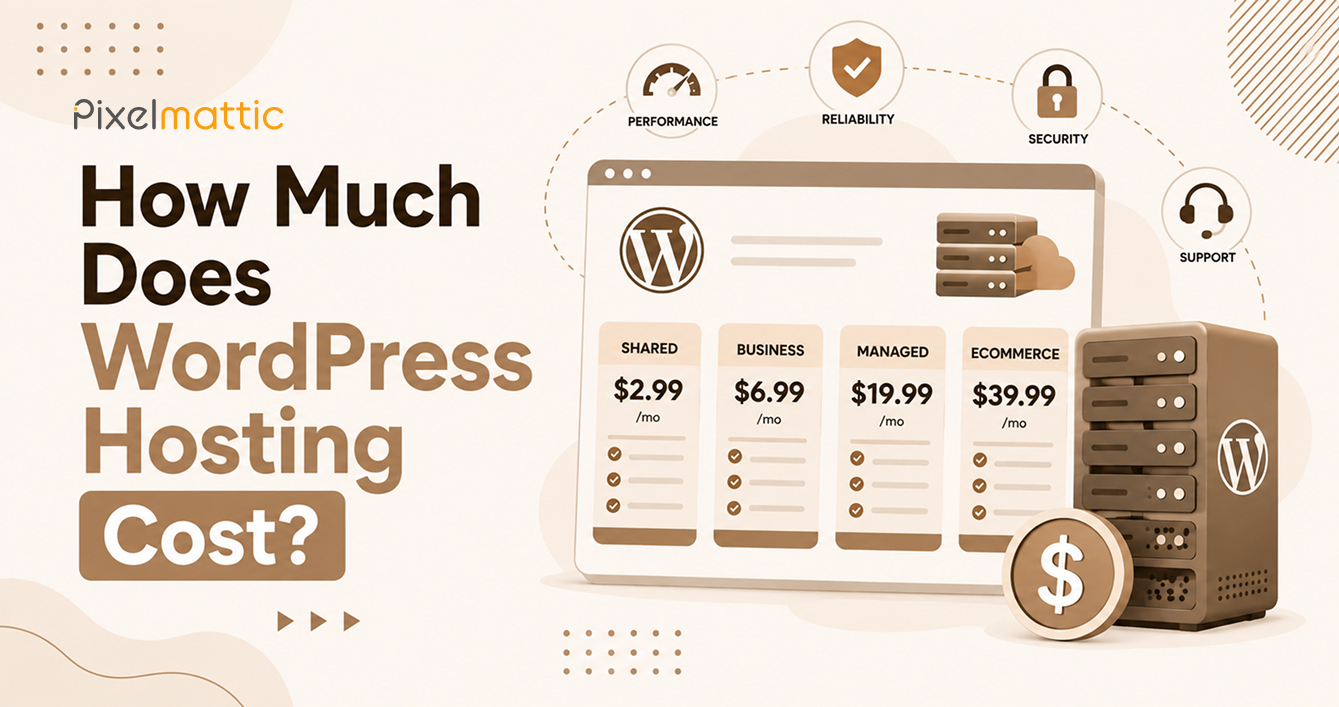
How Much Does WordPress Hosting Cost?
 WordPress Development
|
WordPress Development
|  4 minutes
Table of Contents
- Types of WordPress Hosting
- What Drives the Price Difference
- Why Cheap Hosting Often Costs More Long-Term
- Choosing the Right Tier for Your Business
- Hidden Hosting Costs to Watch For
- Frequently Asked Questions
Hosting is one of the most overlooked line items in a WordPress budget — and one of the most consequential. Cheap hosting is a common cause of slow, unreliable, and vulnerable websites, while overpaying for enterprise infrastructure you don’t need wastes budget better spent elsewhere.
This guide explains what actually drives WordPress hosting costs and how to choose the right tier for your specific business needs.
Types of WordPress Hosting
Shared hosting: $3–$15/month. Your site shares server resources with potentially hundreds of other websites. Suitable only for very low-traffic, low-stakes sites, given the performance and security trade-offs.
VPS (Virtual Private Server) hosting: $20–$100/month. Dedicated resources within a shared physical server, offering meaningfully better performance and stability than shared hosting.
Managed WordPress hosting: $25–$300/month. Hosting specifically optimised for WordPress, typically including automatic updates, built-in caching, enhanced security, and specialised support. Providers like WP Engine, Kinsta, and Cloudways fall into this category.
Dedicated hosting: $100–$500+/month. An entire physical server dedicated to your site alone. Appropriate for high-traffic websites with substantial resource demands.
Cloud hosting: $20–$500+/month, scaling with usage. Resources scale dynamically based on traffic, making this a flexible option for businesses with variable or growing traffic patterns.
What Drives the Price Difference
Server resources (CPU, RAM, storage): Higher-tier hosting allocates more dedicated resources, directly improving page load speed and the ability to handle traffic spikes.
Managed services included: Automatic backups, security monitoring, malware scanning, and staging environments add meaningful value and justify higher pricing.
Support quality: Premium managed hosting typically includes WordPress-specific support (rather than generic hosting support), often with faster response times and deeper platform expertise.
Performance infrastructure: CDN integration, advanced caching layers, and server-level optimisation specifically for WordPress meaningfully affect both cost and site speed.
Traffic and resource allowances: Plans are often tiered by expected traffic volume, storage needs, and number of sites hosted.
Why Cheap Hosting Often Costs More Long-Term
Budget shared hosting frequently results in slow page load times (directly affecting SEO rankings and conversion rates), higher vulnerability to security incidents (due to shared server environments and less rigorous security infrastructure), and unreliable uptime during traffic spikes.
The cost of lost business from a slow or insecure site frequently exceeds the money saved by choosing the cheapest hosting tier. For any business-critical website, hosting is not the place to minimise cost.
Choosing the Right Tier for Your Business
Small business, low-to-moderate traffic: Managed WordPress hosting in the $25–$60/month range typically offers the best balance of performance, security, and cost for most small business websites.
Growing business with increasing traffic: Mid-tier managed hosting ($60–$150/month) or cloud hosting with scalable resources accommodates growth without requiring a hosting migration every time traffic increases.
High-traffic or business-critical websites: Premium managed hosting or dedicated infrastructure ($150–$500+/month) provides the performance headroom and support responsiveness that high-stakes websites require.
eCommerce websites: Hosting optimised specifically for WooCommerce, with strong database performance and security, is important given the transaction-sensitive nature of eCommerce traffic.
Hidden Hosting Costs to Watch For
Some providers advertise low base prices but charge additional fees for:
SSL certificates: These should be included free in most modern hosting plans.
Backups: Verify whether automated backups are included or offered as a paid add-on.
Staging environments: A genuinely important feature that not all budget hosting tiers include.
Traffic overage fees: Some providers charge additional fees if you exceed allocated bandwidth, visitor, or resource limits.
WordPress Hosting
Not Sure Which Hosting Tier Is Right for Your Business?
Talk to Pixelmattic about hosting recommendations tailored to your traffic and goals.
Frequently Asked Questions
Is cheap WordPress hosting bad for my business?
For business-critical websites, cheap shared hosting often results in slower page speeds and higher security risk, both of which can measurably affect revenue and search rankings. Managed WordPress hosting typically offers a better return on investment.
What’s the difference between shared hosting and managed WordPress hosting?
Shared hosting is generic web hosting where you share server resources broadly with many other sites. Managed WordPress hosting is specifically optimised for WordPress, often including automatic updates, built-in caching, and WordPress-specific support.
How much should a small business budget for WordPress hosting?
Most small businesses should budget $25–$75/month for quality managed WordPress hosting that balances performance, security, and cost appropriately for typical traffic levels.
 September 15, 2026
 WordPress Development
 WordPress Development
 WordPress Development
 WordPress Development