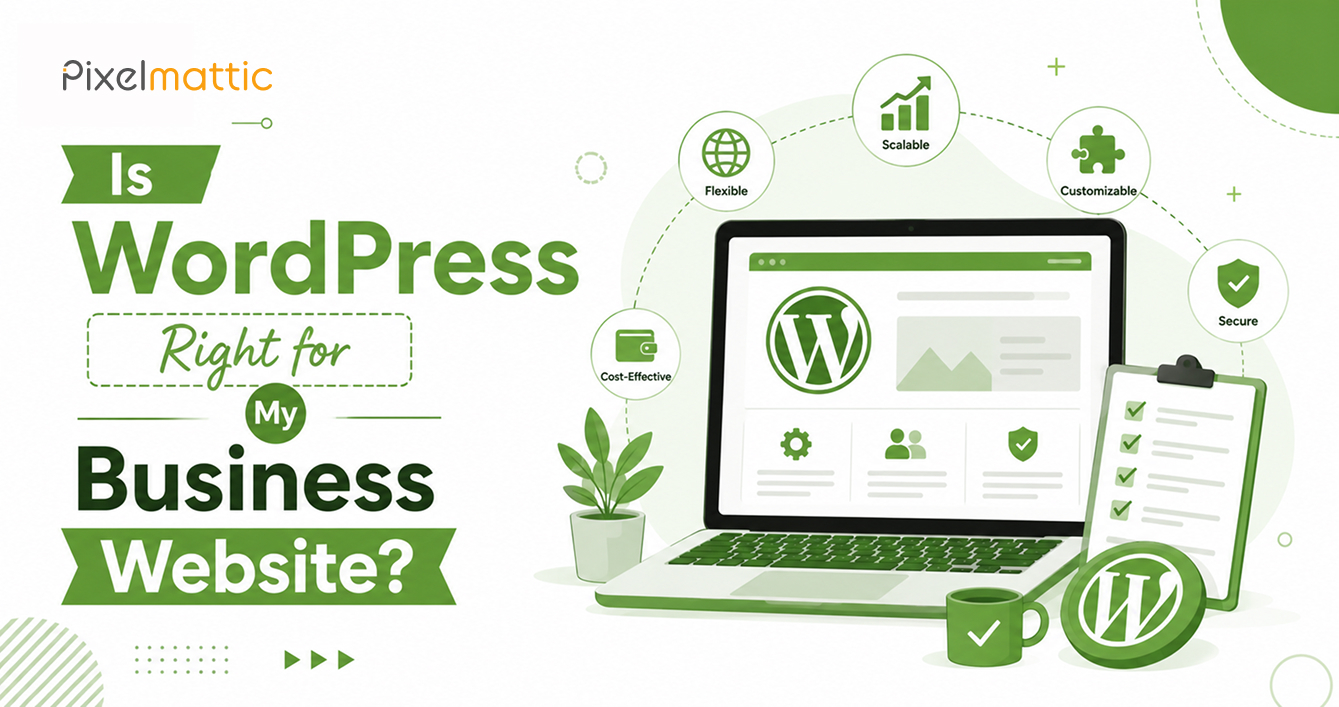
Is WordPress Right for My Business Website?
 WordPress Development
|
WordPress Development
|  4 minutes
Table of Contents
- Why WordPress Remains the Dominant Choice
- Where WordPress Is a Strong Fit
- Where WordPress Has Real Limitations
- Questions to Ask Yourself
- The Honest Bottom Line
- Frequently Asked Questions
With so many website platforms available — Wix, Squarespace, Shopify, Webflow, custom-built solutions — deciding whether WordPress is the right foundation for your business deserves a genuinely honest evaluation, not just a default assumption based on its popularity.
This guide walks through where WordPress genuinely excels, where it has real limitations, and how to make the decision that fits your specific business.
Why WordPress Remains the Dominant Choice
WordPress powers a substantial share of all websites globally — far more than any other content management system. This dominance isn’t accidental. It reflects genuine strengths: an enormous ecosystem of themes and plugins, strong SEO capability, flexibility to build almost any type of website, a large pool of available developers, and full ownership of your code and data (unlike closed platforms where you’re locked into their infrastructure).
Where WordPress Is a Strong Fit
Content-driven businesses: If your business relies on regular publishing — blogs, resources, case studies, news — WordPress’s content management capabilities are best-in-class.
Businesses that expect to grow and evolve: WordPress scales well. A simple brochure site today can evolve into a complex platform with membership functionality, eCommerce, or custom applications without switching systems.
SEO-focused businesses: WordPress’s flexibility around URL structure, metadata, schema markup, and plugin-based SEO tools (like Yoast or Rank Math) makes it a strong platform for organic search strategy.
Businesses that want full ownership: Unlike Wix or Squarespace, where your site lives within their proprietary ecosystem, a self-hosted WordPress site gives you full control over hosting, data, and code.
Where WordPress Has Real Limitations
Maintenance responsibility: Unlike closed platforms that handle updates and security automatically, WordPress requires active maintenance — updates, backups, security monitoring. This is a genuine ongoing responsibility (though manageable through a maintenance retainer).
Quality depends heavily on execution: Because WordPress is so flexible, the quality of the end result depends enormously on who builds it. A poorly built WordPress site can perform worse than a well-built site on a more restrictive platform.
Simple, temporary needs: If you need a very simple, short-lived landing page with minimal ongoing management, a lightweight builder like Carrd or a page within Squarespace may be more efficient than the full WordPress ecosystem.
Highly specific eCommerce at massive scale: For very large-scale, high-transaction-volume eCommerce operations, dedicated platforms like Shopify Plus sometimes offer operational advantages, though WooCommerce (WordPress’s eCommerce plugin) handles the vast majority of business use cases well.
Questions to Ask Yourself
Do I expect my website’s needs to grow or become more complex over time? If yes, WordPress’s flexibility is a meaningful advantage.
How important is search engine visibility to my business? If organic search is a primary channel, WordPress’s SEO capabilities are a strong asset.
Am I comfortable with — or willing to pay for — ongoing maintenance? WordPress requires active upkeep. If you want a fully hands-off platform, factor this into your decision.
Do I want full ownership and portability of my website and data? If avoiding platform lock-in matters to you, WordPress’s self-hosted nature is a significant advantage over closed-platform builders.
The Honest Bottom Line
For most growing businesses — particularly those investing in content marketing, SEO, and long-term digital growth — WordPress remains a strong, defensible choice. Its limitations are manageable with the right development partner and maintenance plan. The platform itself is rarely the constraint; execution quality is what determines whether a WordPress website performs well or poorly.
Not Sure if WordPress Fits Your Business Needs?
Get an honest, no-pressure consultation from Pixelmattic.
Frequently Asked Questions
Is WordPress good for small businesses?
Yes. WordPress offers small businesses an accessible, cost-effective way to build a professional, SEO-friendly website with room to grow, provided it’s built and maintained properly.
Is WordPress better than Wix or Squarespace for business websites?
WordPress offers significantly more flexibility, scalability, and SEO capability than closed-platform builders. Wix and Squarespace can be sufficient for very simple needs, but businesses planning for growth generally benefit from WordPress’s open ecosystem.
Does WordPress work well for eCommerce?
Yes, via the WooCommerce plugin, which powers a significant share of online stores globally. It handles the needs of most small to mid-sized eCommerce businesses well, with dedicated platforms like Shopify Plus becoming relevant primarily at very large operational scale.
 September 17, 2026
 WordPress Development
 WordPress Development
 WordPress Development
 WordPress Development