WordPress Customization Costs: What’s Reasonable?
 WordPress Development
|
WordPress Development
|  4 minutes
Table of Contents
- Why Customization Pricing Varies So Widely
- Cost Ranges by Customization Type
- Factors That Increase Customization Cost
- Custom Development vs. Existing Plugins: Making the Right Call
- Budgeting Realistically
- Frequently Asked Questions
Once you move beyond a standard WordPress build into custom functionality — bespoke features, unique integrations, non-standard design elements — pricing becomes considerably harder to benchmark. Unlike a standard brochure website, custom development cost depends heavily on the specific complexity of what you’re asking for.
This guide gives business owners a realistic framework for understanding and budgeting for WordPress customization costs.
Why Customization Pricing Varies So Widely
Standard WordPress functionality (contact forms, basic galleries, blog listings) is well-served by existing, thoroughly tested plugins — meaning a developer’s job is primarily configuration, not creation. Custom functionality, by contrast, requires original development: planning the logic, writing and testing the code, and ensuring it integrates properly with the rest of your site.
This is fundamentally different work, and pricing reflects that — custom development is billed largely on development hours rather than configuration time.
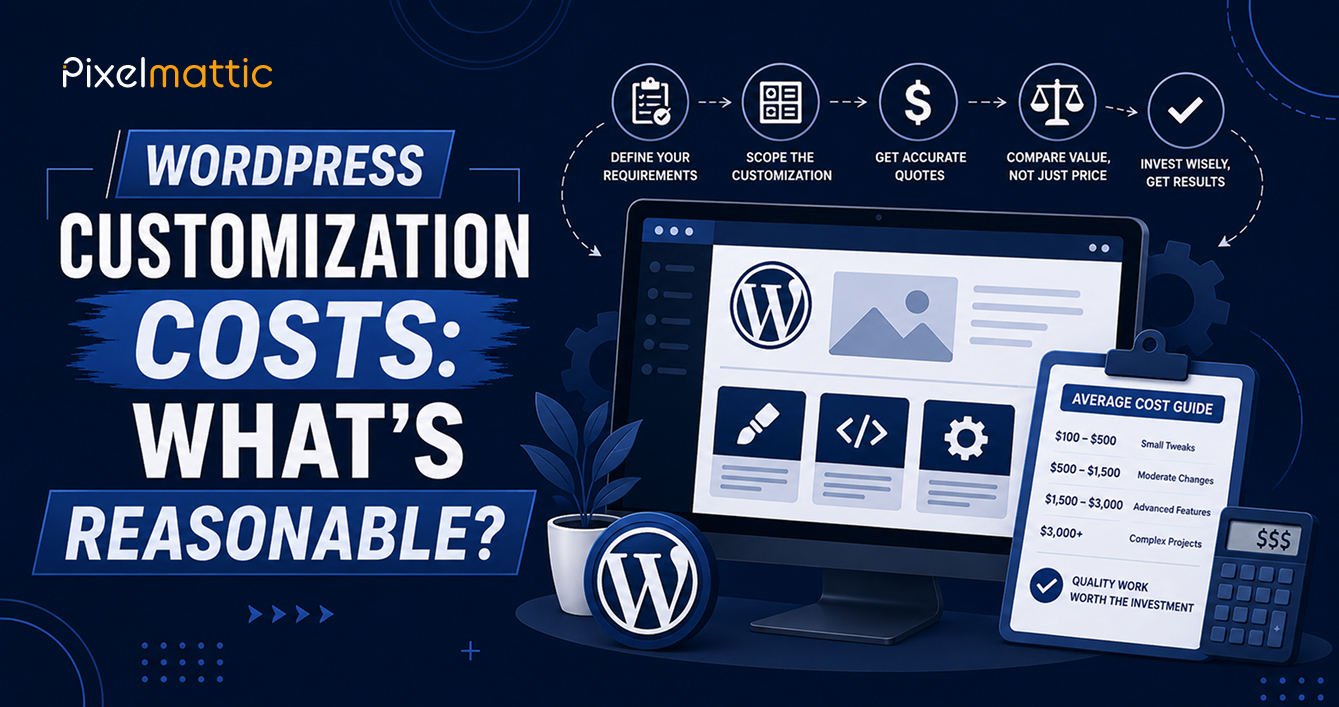
Cost Ranges by Customization Type
Minor customizations ($200–$1,000): Custom styling adjustments, modifying existing plugin behaviour slightly, simple custom fields, or basic layout tweaks beyond theme defaults.
Moderate custom features ($1,000–$5,000): Custom calculators or quote tools, non-standard form logic with conditional fields, custom post types for specialised content, and basic API integrations with third-party tools.
Substantial custom functionality ($5,000–$15,000): Custom membership or subscription systems, booking and scheduling systems with complex availability logic, advanced search and filtering functionality, and deeper integrations with CRM or ERP platforms.
Complex, bespoke systems ($15,000+): Custom marketplace functionality, multi-vendor eCommerce logic, highly specific workflow automation tied to internal business processes, and custom applications built within the WordPress framework that go well beyond typical website functionality.
Factors That Increase Customization Cost
Integration complexity: Connecting to third-party systems (accounting software, CRMs, proprietary internal tools) adds complexity, particularly if those systems have limited or poorly documented APIs.
Data complexity: Features involving complex data relationships, calculations, or conditional logic require more careful architecture and testing than simple, linear functionality.
Security and compliance requirements: Custom functionality handling sensitive data (payment information, personal data, health information) requires additional security consideration and testing, adding to development time.
Ongoing maintenance implications: Custom code, unlike well-established plugins, isn’t maintained by a broader community. Budget for ongoing maintenance of custom functionality as WordPress core and other plugins evolve around it.
Custom Development vs. Existing Plugins: Making the Right Call
Before committing to custom development, it’s worth checking whether an existing, well-maintained plugin can achieve 80-90% of what you need. Custom development makes sense when: your requirements are genuinely unique to your business model, existing plugins create more complexity than they solve, or the functionality is central enough to your business that owning the code outright (rather than depending on a third-party plugin’s continued maintenance) is strategically valuable.
A good developer will tell you honestly when an existing plugin solves your problem adequately, rather than defaulting to custom development simply because it’s more billable work.
Budgeting Realistically
When budgeting for a project involving custom functionality, request a detailed breakdown of hours by specific feature, rather than a single lump-sum quote. This helps you understand where the cost is concentrated and identify whether any specific feature might be simplified to reduce overall cost without significantly compromising your goals.
WordPress Custom Development
Have a Specific Custom Functionality Need in Mind?
Get an honest cost estimate and technical assessment from Pixelmattic.
Frequently Asked Questions
How much does a custom WordPress feature typically cost?
This depends heavily on complexity — minor customizations can cost a few hundred dollars, while substantial custom systems (booking platforms, membership functionality) typically range from $5,000 to $15,000 or more.
Is it cheaper to use a plugin or build custom functionality?
Existing, well-maintained plugins are almost always cheaper than custom development for standard functionality. Custom development becomes cost-justified when your requirements are genuinely unique or when owning the code provides meaningful strategic value.
Do custom WordPress features require ongoing maintenance?
Yes. Unlike widely-used plugins maintained by broader communities, custom code requires your own developer or agency to maintain it as WordPress core and other site components continue to evolve.
 September 29, 2026
 WordPress Development
 WordPress Development
 WordPress Development
 WordPress Development