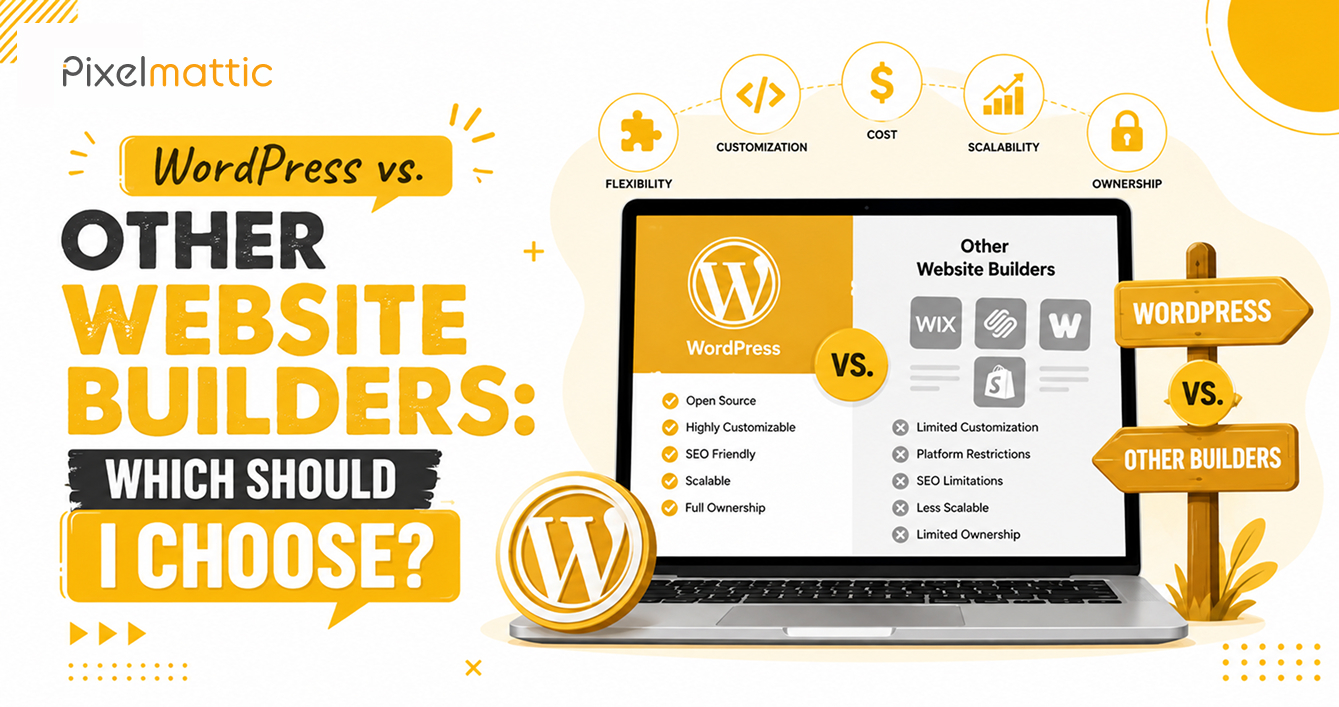
WordPress vs. Other Website Builders: Which Should I Choose?
 WordPress Development
|
WordPress Development
|  4 minutes
Table of Contents
- WordPress
- Wix
- Squarespace
- Webflow
- Shopify
- The Decision Framework
- The Honest Conclusion
- Frequently Asked Questions
Choosing a website platform is a decision with long-term consequences — it affects your flexibility, ongoing costs, SEO potential, and how easily your site can grow with your business. With WordPress, Wix, Squarespace, Webflow, and Shopify all vying for attention, business owners need a genuinely honest comparison, not marketing claims.
This guide compares the major platforms across the factors that actually matter for a business website.
WordPress
Strengths: Unmatched flexibility and extensibility through its plugin ecosystem, strong SEO capability, full ownership of code and data, scales well from simple sites to complex applications, and the largest pool of available developers globally.
Weaknesses: Requires active maintenance (updates, security, backups), quality depends heavily on who builds it, and the learning curve can be steeper for non-technical users without proper training.
Best for: Businesses planning to grow, content-driven organisations, SEO-focused strategies, and anyone who wants full ownership and long-term flexibility.
Wix
Strengths: Genuinely easy drag-and-drop interface, good for very simple sites, hosting and security handled entirely by Wix, and fast initial setup.
Weaknesses: Limited flexibility for custom functionality, SEO capability has historically lagged behind WordPress (though it has improved), your site is locked into Wix’s ecosystem with limited migration options, and scaling to complex functionality is difficult or impossible.
Best for: Very small businesses or solo entrepreneurs with simple needs and no plans for significant future complexity.
Squarespace
Strengths: Strong out-of-the-box design aesthetics, particularly suited to visually-driven businesses (photography, design, creative services), simple to use, and hosting is handled entirely by the platform.
Weaknesses: Similar to Wix, limited flexibility for custom functionality, proprietary ecosystem limits portability, and less suited to complex, content-heavy, or highly SEO-competitive strategies.
Best for: Creative and visually-driven small businesses that prioritise design polish over functional complexity.
Webflow
Strengths: Excellent design control without needing to write code, strong for marketing and landing page-focused sites, and clean, modern output.
Weaknesses: Steeper learning curve than Wix or Squarespace despite being a no-code tool, content management capability is less robust than WordPress for large content libraries, and hosting is tied to Webflow’s platform.
Best for: Design-focused marketing sites and landing pages where visual precision matters more than extensive content management or complex functionality.
Shopify
Strengths: Purpose-built for eCommerce with strong payment, inventory, and shipping integrations, reliable performance at scale, and extensive app ecosystem for retail-specific functionality.
Weaknesses: Less flexible than WooCommerce (WordPress’s eCommerce plugin) for non-standard business models, ongoing subscription and transaction fees, and less suited to content-heavy sites that need extensive blogging or resource libraries.
Best for: Dedicated eCommerce businesses, particularly at scale, where retail-specific functionality outweighs the need for content flexibility.
The Decision Framework
Ask yourself: How much do I expect my website’s complexity to grow over time? (Favours WordPress for anything beyond simple needs.) Is my business primarily content-driven, or primarily transactional retail? (Content favours WordPress; heavy retail favours Shopify.) How important is full ownership and platform independence to me? (WordPress offers the most portability.) Do I have — or plan to have — dedicated technical support for ongoing maintenance? (If not, a fully-managed platform like Wix or Squarespace reduces the maintenance burden, at the cost of flexibility.)
The Honest Conclusion
There is no universally ‘best’ platform — only the best fit for your specific business context. For most growing businesses that value SEO, content flexibility, and long-term scalability, WordPress remains the strongest overall choice, provided you invest in proper development and ongoing maintenance. For very simple, low-complexity needs, Wix or Squarespace can be entirely reasonable choices.
Website Platforms
Not Sure Which Platform Fits Your Business?
Get an honest platform recommendation from Pixelmattic based on your specific goals.
Frequently Asked Questions
Is WordPress better than Wix for a business website?
For businesses expecting growth, strong SEO performance, or custom functionality, WordPress generally offers more long-term value. Wix can be sufficient for very simple, low-complexity sites where ease of use is the primary priority.
Which platform is best for SEO?
WordPress is widely regarded as offering the strongest SEO capability among major platforms, due to its flexibility around technical SEO elements, plugin support, and content structure control.
Can I switch platforms later if I start with Wix or Squarespace?
Migration is possible but more difficult than migrating from WordPress, since Wix and Squarespace use proprietary systems with limited export capability. This is an important consideration if platform flexibility matters to your long-term plans.
 October 1, 2026
 WordPress Development
 WordPress Development
 WordPress Development
 WordPress Development