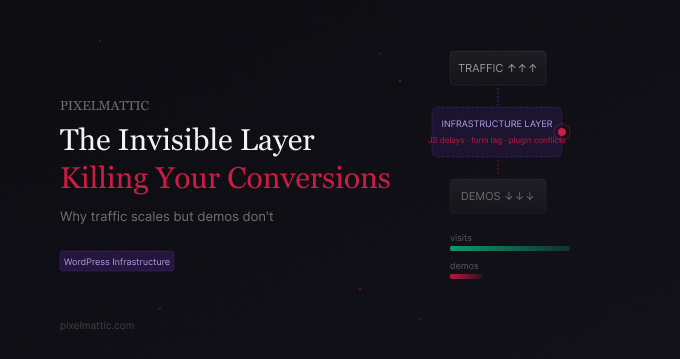
The Invisible Layer Killing Your Conversions
 SEO
|
SEO
|  4 minutes
Why Your Demo Conversion Rate Is Stuck (And It’s Not Your Marketing)
Table of Contents
- The Infrastructure Layer
- JS Load Order Conflicts
- Form Lag on High-Intent Pages
- Plugin Conflicts Creating Silent Failures
- TTFB Degradation on Core Conversion Paths
- Conclusion
You’re spending on paid search. Organic is improving. Your homepage is converting visitors to signups at a reasonable clip. But demo requests — the metric that actually feeds your pipeline — are plateaued. The acquisition math looks right. The conversion math does not.
Most teams respond by testing copy, adjusting CTAs, or rebuilding the landing page again. Some hire an agency to run A/B tests on button color. None of that is wrong, exactly. But it’s addressing the surface when the friction lives one layer below.
The infrastructure layer is invisible until it isn’t.
Between your paid click and your demo form submission sits a chain of WordPress plugins, third-party JS embeds, server response delays, and form libraries — none of which were designed to work together under load. They accumulate over time: a chat widget here, a heatmap script there, a cookie consent tool that blocks rendering. Individually, each seems harmless. Together, they create a decision window — the 2–4 seconds where a qualified buyer is either building confidence or quietly closing the tab.
Here’s what that actually looks like in practice:
JS load order conflicts.
Your demo request form depends on a HubSpot embed that fires after three other blocking scripts resolve. On a good connection this adds 900ms. On a mobile LTE connection, it adds 3.2 seconds — which your analytics dashboards average away. The buyer who came from your LinkedIn ad and bounced never showed up as a form abandonment. They showed up as a session under 30 seconds.
Struggling With WordPress Performance At Scale?
Form lag on high-intent pages.
The /request-demo page loads quickly in Lighthouse. But Lighthouse measures the page in isolation. In the wild, your CRM tracking pixel, retargeting tags, and live chat script all compete on first interaction. The form field responds slowly enough that 15–20% of users who begin typing do not submit. This is not a copy problem.
Plugin conflicts creating silent failures.
A caching plugin and a form plugin with incompatible nonce handling means that roughly 8–12% of form submissions on cached page loads either fail silently or produce an error state after submission — with no notification to the user and no record in your CRM. The lead is gone. The budget that generated it is not.
TTFB degradation on core conversion paths.
Your WordPress install’s Time to First Byte on the /pricing and /demo pages sits at 600–900ms because of database query accumulation from multiple analytics plugins sharing the same page-level hooks. You don’t notice it on a fast office connection. Your buyer in Chicago on a congested network does.
Conclusion
Across the companies we’ve worked with — typically 10–200 person SaaS teams with mature paid channels — this pattern holds: the bottleneck is rarely the offer and rarely the ad. It’s the 80-second window between click and form submission, where four or five infrastructure decisions made over 18 months have compounded into meaningful revenue leakage.
Most of this is diagnosable in a single audit. The fixes are rarely dramatic — they’re sequencing decisions, script consolidation, caching rule adjustments, and form infrastructure choices that align with how buyers actually behave on mobile under real-world conditions.
If your demo conversion rate feels stuck despite healthy traffic, there’s a reasonable chance the problem is already visible in your data — you just need to know where to look.
We’re happy to take a look at your stack and tell you exactly where the friction is. No pitch, no proposal — just a direct assessment of what’s slowing you down.
 April 7, 2026
 SEO
SEO