Why Do Some WordPress Sites Cost $5,000 and Others $50,000?
 WordPress Development
|
WordPress Development
|  4 minutes
Table of Contents
- Design: Templated vs. Fully Custom
- Discovery and Strategy Work
- Custom Functionality and Integrations
- Team Structure and Expertise
- Performance and Technical Rigor
- Testing and Quality Assurance
- Post-Launch Support and Documentation
- How to Decide What You Actually Need
- Frequently Asked Questions
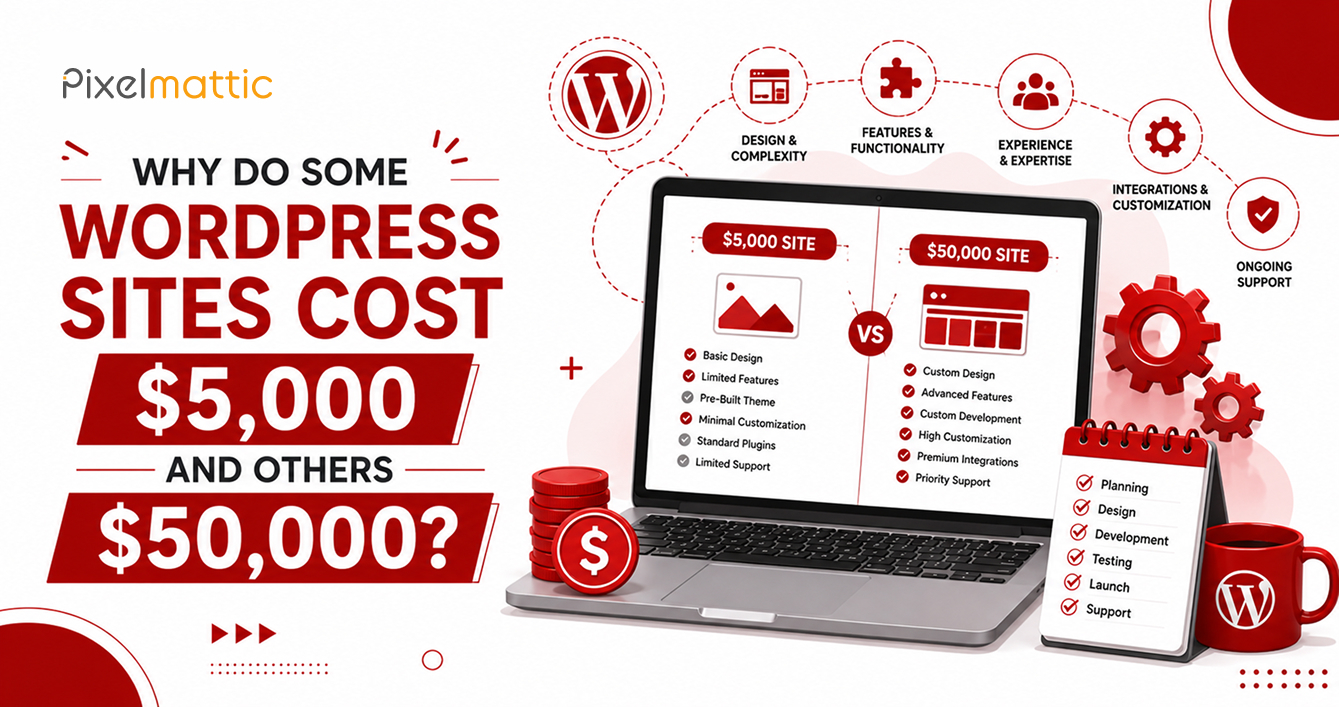
It’s a genuinely confusing situation for business owners: two agencies both quote ‘a professional WordPress website’, and one comes in at $5,000 while the other quotes $50,000. Both are technically using the same underlying platform — so what actually accounts for a tenfold difference?
This guide breaks down exactly where that price difference comes from, so you can evaluate quotes with a clearer understanding of what you’re actually paying for.
Design: Templated vs. Fully Custom
At the $5,000 tier, design typically means customising a premium theme — adjusting colours, fonts, and layout within the constraints of that theme’s existing structure. At the $50,000 tier, every page is designed from scratch based on original wireframes, user research, and brand strategy, with no template constraints.
The difference isn’t just aesthetic — a fully custom design process typically includes UX research, conversion-focused layout decisions, and iterative testing that templated approaches simply don’t include.
Discovery and Strategy Work
Lower-cost projects often skip formal discovery entirely — the developer takes your brief and starts building. Higher-cost engagements typically include stakeholder interviews, competitor analysis, user persona development, information architecture planning, and content strategy — all before any design work begins.
This upfront investment reduces costly changes later and results in a site built around actual business objectives, not just aesthetic preference.
Custom Functionality and Integrations
A $5,000 site typically uses off-the-shelf plugins for standard functionality (contact forms, basic galleries). A $50,000 site often includes custom-built functionality — bespoke calculators, unique interactive tools, deep integrations with CRM or ERP systems, and features that don’t exist as pre-built plugins and must be developed from scratch.
Team Structure and Expertise
At the lower end, a single developer (or small freelance team) often handles design, development, and content simultaneously. At the higher end, you’re typically paying for a specialised team: a dedicated UX designer, a senior developer, a project manager, a QA specialist, and often a copywriter or SEO strategist — each bringing deep expertise to their specific discipline rather than one person spreading across all of them.
Performance and Technical Rigor
Higher-cost projects typically invest significantly more in performance optimisation — custom caching configuration, image optimisation pipelines, code minification, and rigorous Core Web Vitals testing. This level of technical rigor takes considerably more time and expertise than a standard build, but delivers measurably better search rankings and user experience.
Testing and Quality Assurance
Budget projects often have limited, informal testing — a quick check across a couple of browsers before launch. Premium projects include structured QA processes covering multiple devices, browsers, screen sizes, accessibility standards, and edge-case scenarios (like form validation errors or slow network conditions).
Post-Launch Support and Documentation
Lower-cost projects often end abruptly at launch, with minimal handover documentation. Higher-cost engagements typically include comprehensive documentation, team training sessions, a defined warranty period, and often an ongoing strategic relationship rather than a one-time transaction.
How to Decide What You Actually Need
The right price tier depends on your business context, not an absolute standard of ‘better’. Ask yourself: Is your website a primary revenue or lead-generation channel, or a secondary brand presence? How much does custom functionality genuinely matter to your specific business model? What’s the cost of the website underperforming, compared to the investment required to build it properly?
For many small businesses, the $5,000–$15,000 tier represents genuinely good value. For businesses where the website is central to growth and revenue, the additional investment in strategy, custom design, and technical rigor typically pays for itself through improved conversion and search performance.
WordPress Pricing
Want a Clear, Honest Breakdown of What Investment Level Makes Sense for Your Business?
Get a tailored project estimate from Pixelmattic.
Frequently Asked Questions
Is a $50,000 WordPress website always better than a $5,000 one?
Not necessarily ‘better’ in an absolute sense — it depends on your business needs. A $50,000 site typically includes more custom design, functionality, and strategic work, which is valuable if your website is a primary growth driver, but may be unnecessary investment for simpler business needs.
What’s the minimum I should spend on a professional WordPress website?
For a genuinely professional, SEO-ready business website, most businesses should budget at least $2,000–$3,000 to avoid the risks associated with extremely low-cost, templated builds.
How do I know if I’m being overcharged for a WordPress website?
Request a detailed breakdown of what’s included in the quote — design process, functionality, testing, and support. Compare this against at least two other quotes covering similar scope to establish a realistic price range for your specific requirements.
 September 8, 2026
 WordPress Development
 WordPress Development
 WordPress Development
 WordPress Development