
Why Marketing Teams Get Blamed for Problems Caused by Their Website
 Strategy
|
Strategy
|  4 minutes
Table of Contents
- The Attribution Problem
- The Organizational Bias Toward Visible Work
- What the Data Reveals When You Look
- Fixing the Accountability Gap
It’s one of the most demoralizing patterns in digital business: a marketing team executes a well-planned campaign, drives qualified traffic at a reasonable cost per click, and then watches conversion rates fall short of targets. Leadership reviews the numbers. The verdict is almost always the same — the marketing isn’t working. Budget gets cut. The team gets scrutinized. Sometimes people get fired.
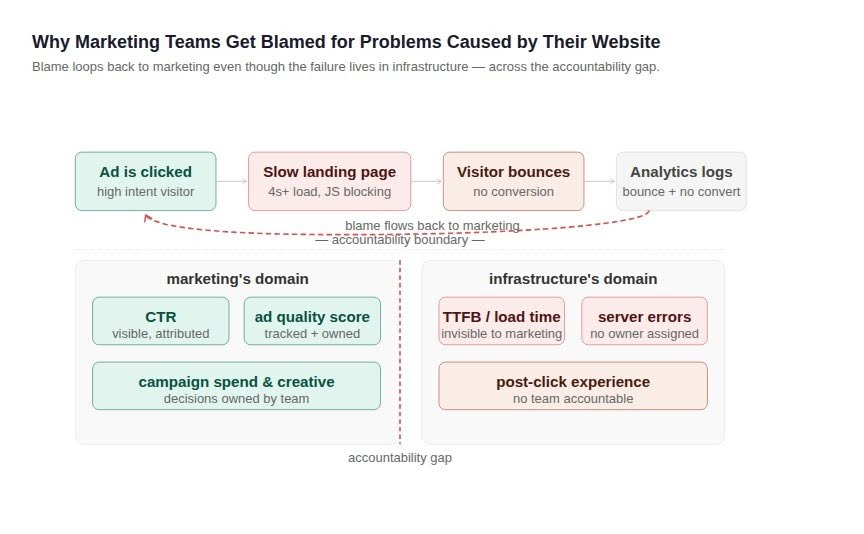
What rarely gets examined is the website the campaign was sending traffic to. Not the copy or the design — those get reviewed obsessively. The technical infrastructure. The server response time. The page load experience on a mid-range Android phone on a 4G connection. The three-second delay before the form becomes interactive. The invisible tax that the site imposes on every dollar the marketing team spends.
The Attribution Problem
Marketing metrics are designed to measure what happens before the click. Impressions, click-through rates, cost per click, audience quality — all of these are visible and attributable. What happens after the click lives in a different system, owned by a different team, measured by different people. The handoff between marketing and website is where accountability dissolves.
When a visitor clicks an ad and bounces in under three seconds because the landing page loaded slowly, that bounce is often recorded as a marketing failure. The campaign drove traffic that didn’t convert. The CPA was too high. The conclusion: the marketing was bad. The actual cause — a page that took 4.8 seconds to become interactive on mobile — never surfaces in the post-mortem.
Struggling With WordPress Performance At Scale?
The Organizational Bias Toward Visible Work
Marketing spend is visible. It’s a line on a budget. Every dollar spent on paid campaigns can be traced to a decision. Website infrastructure, by contrast, is often treated as a fixed cost — something that exists, runs, and is maintained reactively when something breaks. The idea that inadequate infrastructure could be the primary cause of poor campaign performance doesn’t fit the mental model most organizations apply to their digital operations.
This creates a systematic bias: marketing activity gets scrutinized because it’s variable and attributable, while infrastructure problems persist because they’re invisible and belong to no single owner. The team accountable for conversion rate is rarely the team accountable for server response time.
What the Data Reveals When You Look
The simplest diagnostic is to compare your site’s performance metrics against your conversion data over time. Pull your average page load time or TTFB from Google Search Console or a real-user monitoring tool, and overlay it with your campaign conversion rates. In most organizations where infrastructure is the silent culprit, you’ll see a clear inverse relationship — as site performance degrades, conversion rates fall, and as performance improves, they recover, independent of any campaign changes.
Segmenting conversion data by device type is equally revealing. If your desktop conversion rate is healthy while mobile converts at a fraction of the rate, and your site hasn’t been specifically optimized for mobile performance, you’re looking at an infrastructure and optimization problem, not a marketing one. Over 60% of paid traffic arrives on mobile devices. A site that performs adequately on desktop but poorly on mobile is systematically destroying the majority of its marketing investment.
Fixing the Accountability Gap
The organizations that solve this problem do so structurally. They create shared ownership between marketing and technology for conversion rate, not just for their respective activities. They instrument their sites with real-user monitoring so that page performance is visible to the same people who see campaign performance. They run regular technical audits of high-traffic landing pages, not just periodic redesigns.
Most importantly, they treat a slow website as a marketing problem — because that’s exactly what it is. Every second of load time is a conversion tax paid by marketing budget. Making that tax visible to leadership is the first step toward fixing it.
Marketing teams deserve to be judged on the quality of their work. But they can only be fairly judged when the infrastructure delivering their work is given the same scrutiny as the campaigns themselves.

 August 18, 2022
 Strategy